
NREMT Exam: How to Pass on Your First Try

Key takeaways
- The NREMT cognitive exam uses computer adaptive testing, so questions get harder or easier based on your answers and the test ends once your competency is clear.
- In 2024, about 74 percent of candidates passed the EMT cognitive exam on the national level, so a focused study plan matters.
- Build your prep around the national EMS Education Standards: airway, cardiology, trauma, medical emergencies, obstetrics and EMS operations.
- If you do not pass, you can wait 15 days and try again, with up to six total attempts before full retraining is required.
- Practice psychomotor skills out loud and in order so the sequence becomes automatic under pressure.
You pass the NREMT exam on your first try by understanding how the adaptive test thinks, studying from the national EMS Education Standards, and rehearsing your skills until the steps feel automatic. Preparation beats panic. This guide walks through what the NREMT exam covers, how the computer adaptive format works, which study habits actually move your score, how to master the psychomotor skills stations, and what to do if the first attempt does not go your way.
The National Registry of Emergency Medical Technicians certifies EMS providers across the United States, and its exam is the gate between your training and your first job. Treat it as a skill you can prepare for, not a lottery you hope to win.
What Does the NREMT Cognitive Exam Cover?
In 2024, roughly 74 percent of candidates passed the EMT cognitive exam at the national level, according to the National Registry of Emergency Medical Technicians (NREMT Maps and Data, 2024). That pass rate tells you two things. Most prepared candidates succeed, and a real share do not, usually because their study was scattered instead of aligned with the tested content.
The exam is built on the national EMS Education Standards. Questions are spread across major clinical and operational areas:
- Airway, respiration and ventilation
- Cardiology and resuscitation
- Trauma
- Medical and obstetrics/gynecology emergencies
- EMS operations
A large share of the exam treats every patient as an adult, with a dedicated slice covering pediatric, geriatric and obstetric patients. If you can confidently manage an airway, recognize shock, and run a basic cardiac arrest sequence, you have covered a big part of the test.

New EMTs often underestimate EMS operations and scene management questions. These cover scene safety, incident command, lifting and moving, and documentation. They are easy points if you study them and easy losses if you skip them because they feel less exciting than trauma.
How Does the Adaptive Testing Format Work?
The NREMT cognitive exam uses computer adaptive testing, so the difficulty of each question responds to how you answered the last one. The National Registry confirms this adaptive design in its EMT candidate materials (NREMT EMT Cognitive Exam, 2026). Get an item right and the next one tends to be harder. Miss one and the next tends to be easier.
Because the test adapts, the number of questions is not fixed, and it is not the same for everyone. The engine keeps serving items until it has enough evidence to place your ability clearly above or below the passing standard. When that confidence threshold is reached, the exam ends. A short test is not automatically a good sign or a bad one.
This design changes how you should think during the exam. You cannot skip ahead, flag items and return later, or review answered questions. Each answer locks before the next question appears, so give every item your full attention the first time.
Here is the mindset that helps most: answer each question as if it matters, then let it go. Candidates who panic after a run of hard questions often forget that hard questions usually mean they are performing well. Steady pacing and calm reading beat second-guessing.
What Study Resources and Practice Test Tips Actually Work?
Effective NREMT study maps directly to the EMS Education Standards and uses practice questions as a diagnostic, not a memory drill. The goal is not to recognize specific questions on test day. It is to reason through any question the standard can produce.
Build your plan around a few proven habits:
- Study by content area, not by random review. Rotate through airway, cardiology, trauma, medical, OB and operations so no domain is neglected.
- Use practice questions to find gaps. When you miss one, trace it to the underlying topic and restudy that topic before moving on.
- Read full rationales. Understanding why the wrong answers are wrong teaches the clinical reasoning the exam rewards.
- Simulate real conditions. Practice in longer sittings so focus and stamina are trained, not just knowledge.
- Prioritize official and standards-based sources. Start with the National Registry candidate materials and your program's approved curriculum.

Space your studying across weeks rather than cramming the night before. Short, frequent sessions build durable recall far better than one long marathon. A practice score that climbs steadily over several weeks is a reliable signal that you are ready.
If you are still early in your path and want the full picture from enrollment to certification, a clear step-by-step plan helps the exam fit into a broader career timeline rather than standing alone.
How Do You Master the Psychomotor Skills Stations?
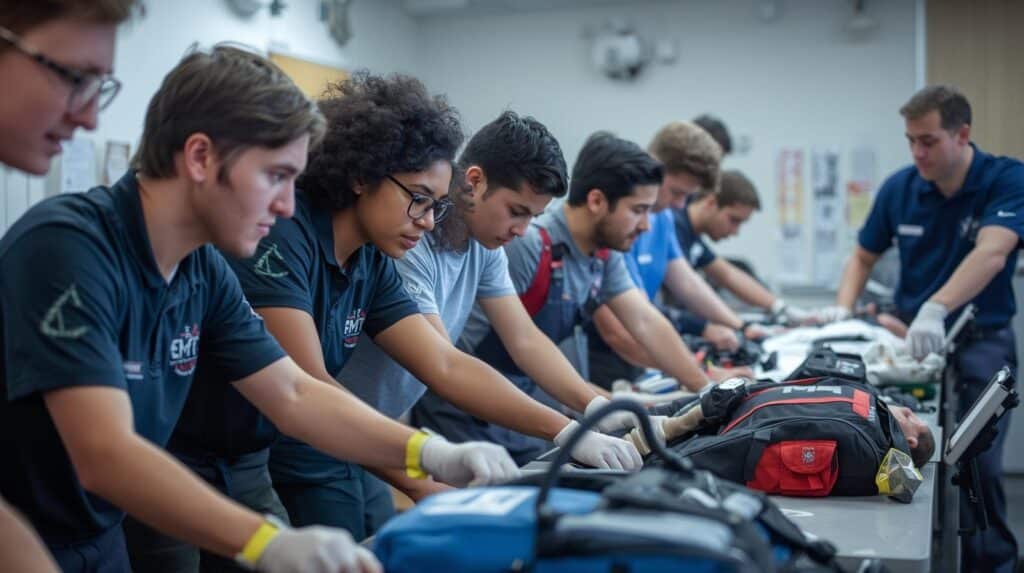
You master the psychomotor skills by rehearsing each station out loud, in the correct order, until the sequence runs on muscle memory. The skills evaluation tests whether you can perform core EMT tasks safely and in a defensible order, not whether you can recite a textbook. Scene safety and standard precautions are often the first scored steps, and forgetting them is a common, avoidable failure.
Typical EMT skills stations assess tasks such as:
- Patient assessment for medical and trauma patients
- Bag-valve-mask ventilation of an apneic patient
- Oxygen administration
- Spinal motion restriction
- Bleeding control and shock management
The skill sheets are published, so there is no mystery about what examiners want. Print them, read each critical criterion, and practice narrating every step as you perform it. Saying the steps aloud forces you to prove you did them and keeps you from skipping a scored action under stress.
Practice with a partner playing the patient and a second person reading the skill sheet as a grader. Repetition under light pressure makes the real station feel familiar. The candidates who freeze are usually the ones who only read the steps and never physically ran them.
What Should You Do If You Do Not Pass the First Time?
If you do not pass, you can retest after a short waiting period, and most candidates who restudy strategically pass on a later attempt. The National Registry requires you to wait 15 days from your last attempt before testing again, and you have up to six total attempts, with mandatory remedial training required after three failed tries (NREMT EMT Cognitive Exam, 2026). A first failure is a setback, not the end of your EMS career.
After an unsuccessful attempt, the National Registry provides feedback showing which content areas were below the standard. Use that report as your study map. Pour your energy into the weakest domains rather than reviewing everything equally.
A simple recovery plan works well:
- Read your feedback and list every area marked below standard.
- Rebuild your study schedule around those specific domains.
- Run fresh practice questions in each weak area until your accuracy is consistent.
- Rehearse any skills that felt shaky before you retest.
Once you pass and earn certification, your focus shifts to landing the role. A sharp application makes a real difference, and our guide to writing an EMT resume that gets interviews helps you present your new credential well. When you are ready to apply, Emtjobs lists EMT, EMS and paramedic openings from employers across the United States, so you can match your certification to local hiring near you.
Your next step is practical: schedule your exam only after your practice scores are consistently strong across every content area, print the current skill sheets, and rehearse them aloud until the sequence feels automatic. Walk in prepared, read each question fully, and trust the work you put in.
Frequently asked questions
How many questions are on the NREMT EMT cognitive exam?
The EMT cognitive exam uses a computer adaptive format, so the number of questions varies from one candidate to the next. The test stops once it has enough evidence to decide whether you meet the passing standard.
What is the NREMT passing score?
There is no fixed percentage to hit. The adaptive engine measures your ability against a set competency standard and keeps testing until it can place you clearly above or below it. The result is reported as a simple pass or fail.
How soon can I retake the NREMT if I fail?
You must wait 15 days from your last attempt before testing again. You have up to six total attempts. After three failed tries you must complete remedial training before continuing.
How long are NREMT practice tests useful for studying?
Practice tests help most when you use them to find weak content areas rather than to memorize answers. Review every question you miss, trace it back to the standard it tests, and restudy that topic before your next practice round.
Related Posts:


Does passing the NREMT guarantee I can work as an EMT?
National Registry certification is one requirement. Most states also require state licensure, a background check and other local steps before you can work. Check your state EMS office for the full list that applies to you.