

Firefighter EMT Jobs: How to Combine Both Careers

Key takeaways
- Most fire departments now require EMT certification because the majority of their calls are medical, not fires.
- The fastest route is earning your EMT-Basic certification first, then applying to departments and passing the CPAT physical test.
- Firefighter-EMTs combine a firefighter salary with EMS skills, and paramedic certification raises pay further.
- The CPAT is a timed, pass/fail physical ability test used by many departments as a hiring gate.
- You can search firefighter EMT openings alongside other EMS roles on EmtJobs to compare departments quickly.
If you want firefighter EMT jobs, the path is clear: earn your EMT certification first, then apply to fire departments and pass their physical ability test. The two roles are tied together because most of what a modern fire department responds to is medical, so departments hire people who can fight fire and treat patients on the same shift.
This guide walks through why departments expect EMT certification, how to train for both jobs, what the hiring process looks like, what the combined role pays, and where to find departments that are hiring right now.
Why Many Fire Departments Require EMT Certification
The simplest reason departments want EMT-certified firefighters is call volume. Across the country, the majority of fire department responses are medical and rescue calls rather than structure fires. When someone dials 911 for chest pain, a fall or a car crash, the closest unit is often a fire engine, and the crew on that engine is expected to begin care before an ambulance arrives.
That workload reshaped hiring. A firefighter who can only fight fire sits idle on most calls, so departments screen for EMT skills the same way they screen for strength and composure. Many career departments require an EMT-Basic certification before you can even submit an application. Others let you apply without it but require you to earn it during your probationary year. Large metropolitan departments almost always treat EMT certification as a minimum prerequisite.
For job seekers, the takeaway is practical. EMT certification usually works as the ticket that gets your application past the first cut. If you are weighing whether to start with EMS training, the answer in most markets is yes.
Dual Training Paths for Firefighter-EMTs
There are two common ways people reach a firefighter-EMT role, and the order you choose affects how fast you can get hired.
Path one: EMT first, then fire academy
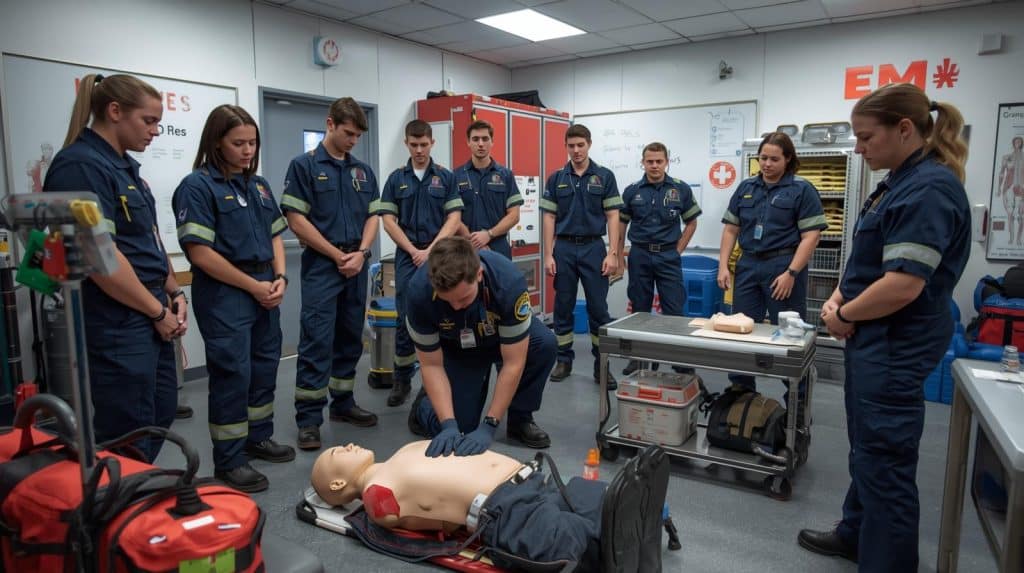
This is the route most candidates take and the one most departments prefer. You complete an EMT-Basic course, which typically runs a few months of classroom, skills labs and clinical or ride-along hours, then pass the National Registry exam to earn certification. If you want a refresher on that exam, our guide on how to pass the NREMT exam on your first try covers the format and study approach.
With certification in hand, you apply to fire departments. Once hired, the department sends you through its fire academy, usually around 12 to 16 weeks, where you learn suppression, ventilation, search and rescue, and apparatus operation. Because you already hold EMT certification, you clear a requirement that would otherwise stall your application.
Path two: hired first, certify on the job
Some departments, often smaller or rural ones, hire candidates who show strong aptitude and then require them to earn EMT certification within a set window, commonly the first 12 to 18 months. This path lowers the upfront barrier but puts a hard deadline on your certification. Miss it and you can lose the job.
Either way, keeping both certifications current is part of the role. EMT certification expires on a cycle and has to be renewed, so build that into your plan early. Many firefighters later go further and become paramedics, which expands the care they can deliver and usually raises pay.
Hiring Process and Physical Requirements
Fire department hiring is more involved than a typical job application, and it moves on the department's schedule rather than yours. Knowing the stages helps you prepare for each one.
A common sequence looks like this:
- Written application and often a civil service or aptitude exam.
- The Candidate Physical Ability Test, or CPAT.
- Oral interview with a panel.
- Background check, medical exam and drug screen.
- Conditional offer, then the fire academy.
The CPAT is the stage that surprises many candidates. It is a nationally standardized physical ability test developed by fire service organizations to be consistent and legally defensible across departments. It is timed and strictly pass/fail, with no credit for finishing faster. Candidates wear a weighted vest and move through a series of firefighting tasks such as a stair climb, hose drag, equipment carry, ladder raise, forcible entry, search, rescue drag and ceiling breach. You can read the official description from the International Association of Fire Chiefs' Candidate Physical Ability Test page. Many testing centers offer orientation and practice sessions, and a current CPAT certificate is valid for a limited period, so time your test close to when departments are hiring.
The interview stage rewards preparation that looks a lot like EMS interview prep. Panels ask about judgment, teamwork and how you handle pressure. Because the medical side of the job matters so much, expect clinical and scenario questions too.
Salary and Benefits of Combined Roles
Pay is one of the strongest reasons to combine the two careers. Firefighter-EMTs are almost always placed on a firefighter salary scale, which generally sits above what a standalone EMT earns, and the combined role comes with the benefits structure of a municipal public safety job.
National labor data from the U.S. Bureau of Labor Statistics shows firefighter pay running meaningfully higher than the median wage for EMTs, with the firefighter job outlook projected to keep growing over the coming decade as departments backfill retirements. Exact figures vary by region, department size and cost of living, so treat local department pay scales as the real benchmark for where you plan to work.
Beyond base salary, the combined role typically includes:
- A public pension or strong retirement plan, which is often the headline benefit of a fire career.
- Health, dental and disability coverage.
- Overtime and shift differentials, which can lift total pay well above base salary.
- Paid training and the chance to certify as a paramedic on the department's dime.
Advancing to paramedic generally raises pay again, which is why so many firefighter-EMTs keep climbing the certification ladder.
How to Find Departments Hiring Firefighter EMTs
Fire department openings do not always surface in the same places as hospital or ambulance EMS jobs, so a focused search saves time.
Start with the departments themselves. Municipal and county fire departments post openings on their city or county career pages, and many run hiring only during specific windows, so set reminders and apply the moment a posting opens. Civil service systems in some states run centralized testing that feeds multiple departments at once, which lets a single exam count toward several applications.
A job board that aggregates EMS and fire-adjacent roles saves you from checking dozens of city sites one at a time. On EmtJobs you can search firefighter and EMT jobs together, filter by location, and compare departments side by side so you are not reconstructing each listing by hand. Because the combined role sits at the overlap of fire and EMS hiring, searching an EMS-focused board surfaces openings that a general job site can bury.
While you wait for a fire department window to open, keep your EMS resume and skills sharp. A clean, current resume carries over directly to fire applications, and our guide on how to write an EMT resume that gets interviews shows how to present clinical experience in a way hiring panels respond to.
The next move is concrete: if you do not already hold EMT certification, enroll in an EMT-Basic course this cycle, then set a CPAT date once you have your certificate. Those two steps, in that order, put you in front of nearly every department hiring firefighter-EMTs.
Frequently asked questions
Do you need to be an EMT to become a firefighter?
Many career fire departments require EMT certification either before you apply or within your first year on the job, because most calls are medical. Some rural or volunteer departments are more flexible.
Should I get my EMT certification before applying to fire departments?
Yes, in most cases. Holding an EMT-Basic certification before you apply makes you eligible for more departments and gives you an edge over candidates who have not started EMS training.
What is the CPAT in firefighter hiring?
The Candidate Physical Ability Test is a nationally standardized, timed pass/fail test of firefighting physical tasks. Many departments require a current CPAT certificate as part of the application.
Do firefighter EMTs earn more than regular EMTs?
Firefighter-EMTs are usually paid on a firefighter salary scale, which tends to be higher than a standalone EMT wage, and advancing to paramedic can raise pay further.
Related Posts:

How long does it take to become a firefighter EMT?
Plan for roughly a year. EMT-Basic training often takes a few months, and after you are hired the fire academy usually runs about 12 to 16 weeks.