
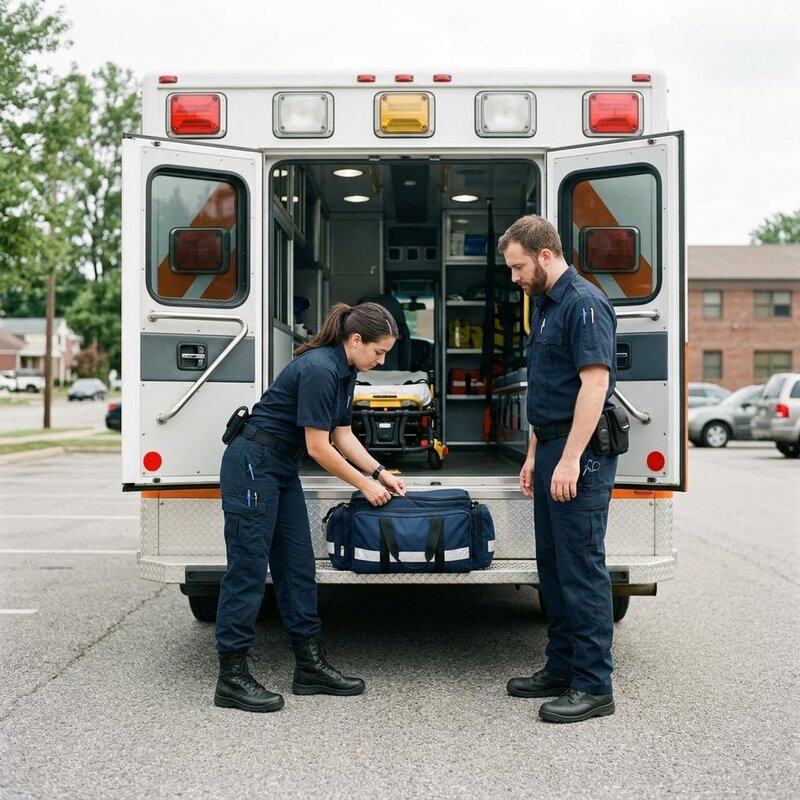
Your First EMT Basic Job Starts With the Right Crew

It is tempting to choose an EMT Basic job by asking who will hire you first. Also ask who will help you settle in. A service that explains its orientation clearly gives you something practical to compare before you accept your first role.
The useful question is not simply whether an employer accepts new graduates. It is how the employer takes a new graduate from the classroom to a dependable member of the crew.
Ask what your first month will involve
Request an outline of the induction process. You might need classroom sessions, equipment checks, driving assessment, documentation training and supervised patient care. The exact sequence varies. What matters is knowing how progress is assessed and who is responsible for supporting you.
A fixed number of orientation days does not tell the whole story. Ask what happens if you need more practice with a task and whether there is a named preceptor or a consistent small group of trainers. Regular feedback is more useful than discovering at the end that nobody thought you were ready.
Understand the work behind the title
EMT roles can involve emergency response, scheduled transport or a mixture. A hospital or clinic position may have a very different routine from an ambulance assignment. Read the duties closely rather than treating every vacancy as the same job with a different uniform.
Ask who you would usually work with, which area the service covers and what calls or transfers it handles. You are not looking for a promise that the job will always be easy. You are checking whether the supervision available suits your experience.
Be specific about driving and lifting support
If driving is part of the role, ask how the service checks driving competence and introduces unfamiliar vehicles or routes. Do not assume that holding a standard driver’s license means you have met every employer or state requirement.
For physical duties, discuss equipment and teamwork rather than making promises you cannot safely keep. Ask how crews request extra help, what patient movement equipment is available and how staff report equipment problems. Clear answers say something about everyday working conditions.
Listen for a useful feedback process
- Will someone review your documentation while you learn the local system?
- How do new staff raise a concern about a call or a workplace practice?
- Are training goals discussed during orientation or only at its end?
- Who is available when the usual supervisor is off duty?
An interviewer does not need to reveal private staff information to answer these questions. They should be able to describe the process. Vague reassurance that everyone helps everyone is less useful than knowing who you can contact and how.
Bring a focused application
Use the EMT Basic job category to find roles matching your current credentials. Check the employer’s live requirements before applying, including state authorization, required cards and any driving conditions.
In your application, distinguish classroom training, supervised placements and paid employment. Describe what you actually did without presenting a training scenario as independent clinical experience. If a credential is pending, give its true status rather than listing it as complete.
Related Posts:



Your first role does not have to be your final career destination. It should provide a manageable introduction to the work, honest expectations and people who can help you develop good habits. Those details deserve as much attention as the advertised hourly rate.