
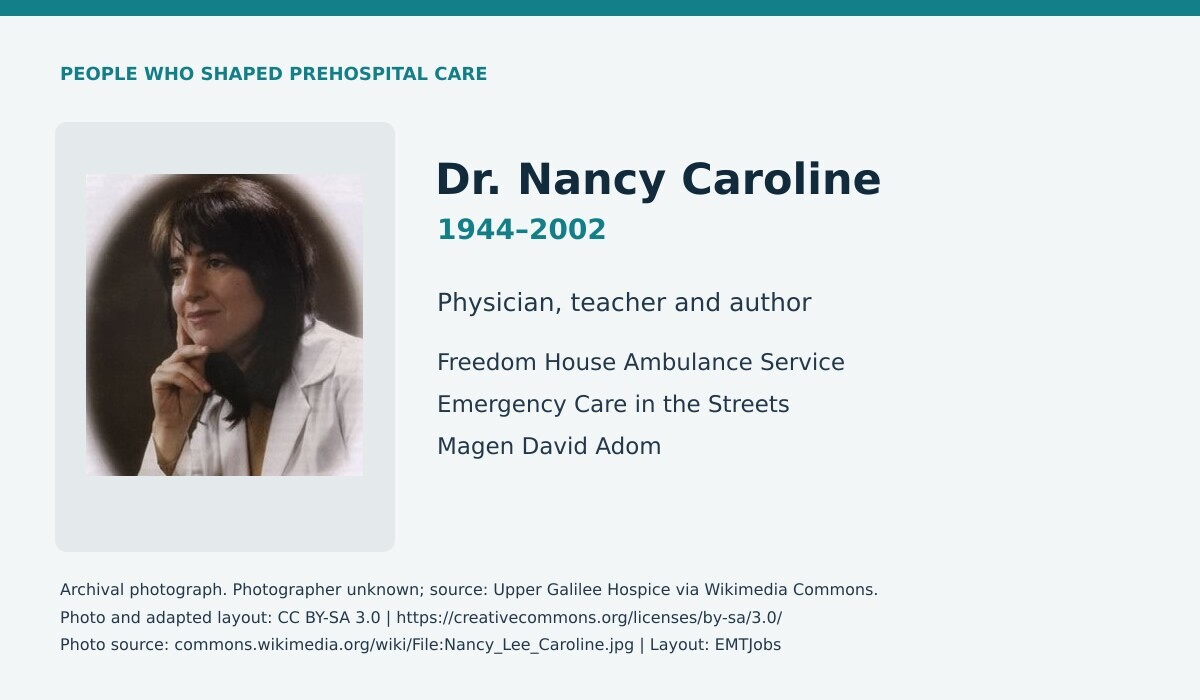
Nancy Caroline: The Doctor Who Helped Shape Paramedic Education

Nancy Caroline’s name is familiar to many paramedic students before they know much about the woman behind it. It appears on Emergency Care in the Streets, a textbook associated with generations of prehospital education. Her career, however, was not confined to writing. She worked with ambulance crews in Pittsburgh, helped develop paramedic education and took that work into very different health systems overseas.
The thread connecting those roles was a practical question: how do you prepare people to deliver skilled care before a patient reaches a hospital? Caroline took that question seriously when the professional identity of the paramedic was still being established. Her story is worth reading as part of EMS history, not because one physician created the profession alone, but because her work shows how teaching, clinical practice and public access to care developed together.
From medical school to prehospital care
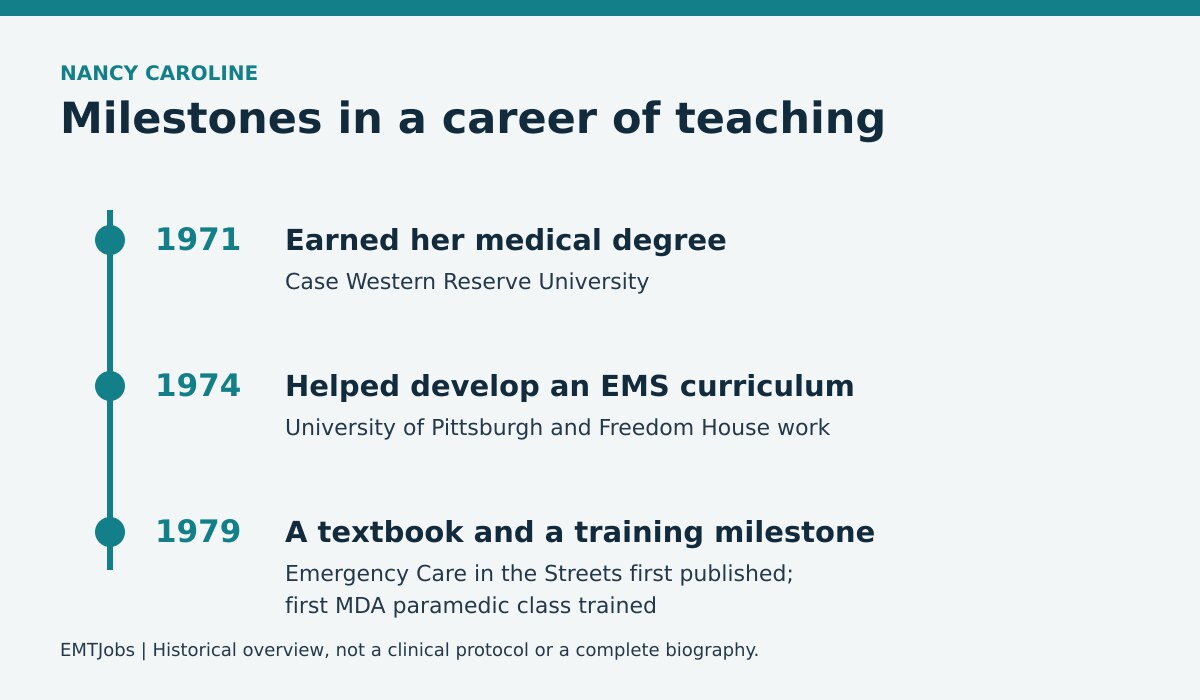
Caroline was born in Newton, Massachusetts, in 1944. She studied at Radcliffe College and earned her medical degree at Case Western Reserve University in 1971. She went to the University of Pittsburgh for critical care training in 1973, where she worked with Peter Safar. Safar was already an important figure in resuscitation medicine and became a mentor during the period that brought her into ambulance education.
Those dates place her early EMS work in a period when ambulance services were changing substantially. The question was no longer only how quickly an injured or ill person could be moved. Communities were also working out what care could be provided during that journey, who should provide it and how they should be trained. Education was central to those changes, not an administrative detail added afterward.
Caroline’s critical care background gave her experience relevant to seriously ill patients. The challenge in prehospital medicine was different from working in a fully equipped hospital, though. Ambulance crews needed teaching that reflected the resources, surroundings and decisions they actually faced. Her later writing addressed that gap directly.
Freedom House and the work in Pittsburgh
Freedom House Ambulance Service is an essential part of this history. Based in Pittsburgh’s Hill District, it trained Black community members as paramedics and became a significant early example of organized prehospital emergency care. Its story includes the crews, community organizers and medical educators who worked against unequal access to services. Describing it simply as a physician’s project would leave out the people who made the service function.
Caroline became involved in teaching Freedom House personnel and served as its medical director. The National EMS Museum’s account describes Safar recruiting her to help train the crews. It also describes her riding with EMTs, an important detail in understanding the kind of educator she became. Teaching ambulance care required familiarity with the conditions outside the classroom, not just knowledge of treatment in a hospital.
In 1974, the University of Pittsburgh received federal support to develop an emergency medical services curriculum. Safar oversaw the project, with much of the work delegated to Caroline. That connection between an operating service and a broader education project helps explain the significance of her Pittsburgh years. Practical experience could inform training intended to reach beyond one neighborhood or one ambulance organization.
Freedom House’s importance should not be measured only through the later careers of the physicians associated with it. The service demonstrated what trained crews could do and gave its members a route into a developing profession. Caroline’s contribution belongs within that collective achievement. It is more accurate, and more useful, than presenting her as the single inventor of modern EMS.
Why Emergency Care in the Streets mattered
Caroline wrote Emergency Care in the Streets when paramedics needed education materials suited to their own role. The National EMS Museum dates the book’s first publication to 1979 and describes a shortage of texts written specifically for prehospital providers. Nursing and physician textbooks could contain relevant medicine without being organized around the circumstances of an ambulance call.
The distinction is easy to overlook if you have only known EMS as an established profession. A dedicated textbook helps define what learners need to understand, what they should be able to do and how the subject fits together. It can give instructors and students a shared structure instead of asking each class to assemble an education from material intended for another occupation.
Accounts collected by the museum emphasize Caroline’s ability to explain complicated subjects clearly. That is not the same as making the work sound easy. Good teaching makes difficult material understandable without pretending that clinical responsibility is simple. A learner needs enough explanation to connect an observation with a decision, rather than memorize a page without understanding its purpose.
The textbook title remains associated with her, but modern editions should not be treated as if every page were written by Caroline personally. Educational books are revised by later contributors as practice changes. Her historical contribution and the content of any particular current edition are related subjects, not interchangeable ones. Students should use the edition required by their program and current clinical guidance.
Building paramedic education in Israel
Caroline later became the first medical director of Magen David Adom, Israel’s national emergency medical organization. Its supporters’ organization, American Friends of Magen David Adom, credits her with founding the organization’s paramedic training program and helping develop mobile intensive care services. Its historical account identifies 1979 as the year she trained the first group of Israeli paramedics.
This part of her career continued the connection between training and service delivery. Preparing advanced prehospital providers was not only a matter of offering a course. The organization also needed the clinical structure and equipment that allowed those skills to be used. Her work linked the education of crews with a wider effort to improve what an ambulance service could provide.
It is worth keeping the historical claim specific. Being an important contributor to paramedic education in Israel does not mean she was responsible for every later development in the country’s emergency services. Nor should a modern staffing figure be presented as a measure of an organization during her tenure. Her role is substantial without attaching unrelated present-day statistics to it.
Work in East Africa and a later focus on hospice care
Caroline also worked with the African Medical and Research Foundation, widely known as AMREF, in East Africa. The National EMS Museum describes her involvement with the Flying Doctors service and her teaching of nonphysician health workers. It was another setting in which the useful question was how to make medical knowledge usable by the people delivering care, rather than assuming that every patient would be reached by a physician.
Later, her work included oncology and hospice care in Israel. She founded the Hospice of Upper Galilee, which also cared for her when she became seriously ill. Caroline died in 2002, aged 58. Her career therefore extended beyond the emergency call and the ambulance textbook into the care of people living with serious illness.
These later roles are not an unrelated footnote. They show the breadth of her medical interests and help prevent a familiar textbook title from standing in for an entire life. Emergency care, rural health education and hospice work require different systems and skills. In her career, each involved finding ways to bring useful care closer to people who needed it.
What today’s EMT and paramedic students can take from her work
One useful lesson is the importance of understanding the job you are learning to do. Caroline’s work with ambulance crews was grounded in the circumstances of prehospital practice. For a student today, that means asking how classroom knowledge connects with assessment, communication and the responsibilities allowed at their training level. Knowing a definition is a beginning, not proof that someone can apply it safely.
Another lesson concerns clear language. A complicated explanation is not automatically a better one. Whether studying with a partner or explaining a concern to a patient, accuracy and clarity belong together. The reputation Caroline earned as an educator rests partly on making difficult ideas accessible. That remains a useful standard for instructors and learners.
Her history also makes a distinction that matters in career planning: EMT and paramedic are not interchangeable qualifications. A biography of a pioneer in paramedic education is not a guide to your current scope of practice. Education standards, certification requirements and local protocols have changed since her early work. Use history to understand the profession, and your approved training and medical direction to understand what you may do now.
A legacy larger than a name on a book
Caroline’s lasting contribution is visible in several places: the education work associated with Freedom House, a textbook written for prehospital learners and the development of paramedic training at Magen David Adom. Together, they explain why her name continues to matter to people who never met her. They also show why the history of EMS is about education and public service as well as equipment and individual acts of rescue.
Related Posts:
The most useful way to remember Nancy Caroline is not as a distant figure credited with doing everything first. It is as a physician and teacher who helped make an emerging field teachable. Her work belongs alongside that of the ambulance crews, colleagues and communities who shaped it. Understanding those connections gives the name on the textbook a much fuller meaning.