
Denver Health EMT Training: Classes, Costs and Certification

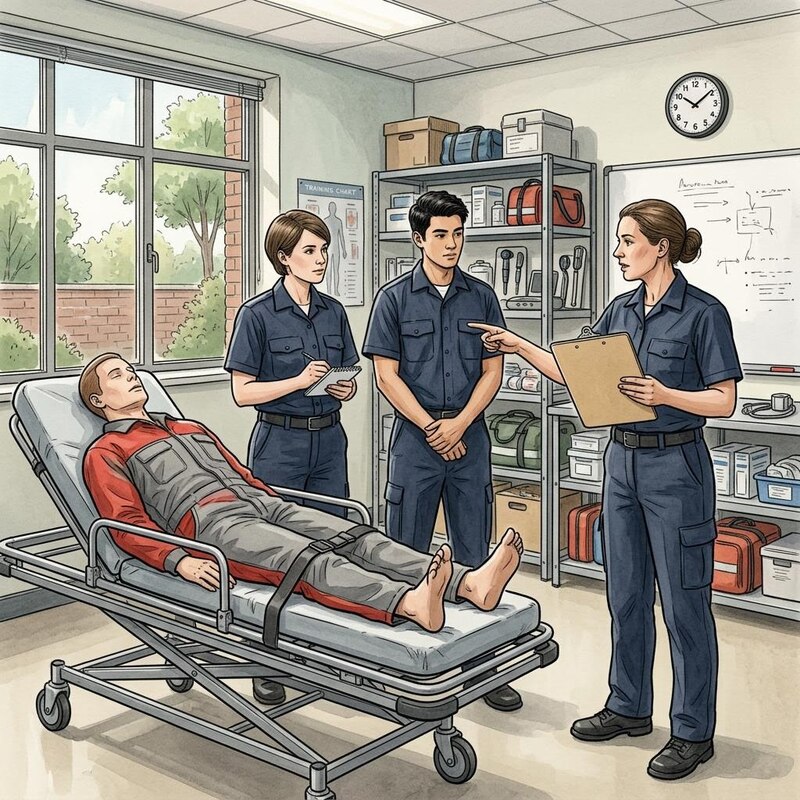
Denver Health EMT training is one option for getting started in emergency medical services in Colorado. Its EMT school combines classroom learning and practical skills instruction, with opportunities to see how prehospital care connects to a working ambulance service and emergency department. Before applying, though, look beyond the program name. The teaching location, weekly timetable and expenses outside tuition can make a real difference to whether a class works for you.
This guide covers Denver Health’s entry-level EMT program, not its paramedic school. Course information was checked on November 12, 2026. The school was advertising several 2027 sessions at that time. Dates, prices and available places can change, so confirm the particular section with Denver Health before paying or rearranging your work schedule. This is an independent overview, not an admissions notice or an endorsement by the school.
What Denver Health’s EMT course includes
The school describes approximately 150 hours of classroom and skills training, taught by paramedics who work in the field. Its published outline follows the National Emergency Medical Services Education Standards. The aim is to prepare beginners to assess patients, provide care within the EMT role and help transport people safely. It is not a shortcut to practicing at the paramedic level.
Denver Health also describes ambulance ride-along opportunities and the chance to complete an emergency department shift. These are useful details to ask about when comparing schools. Find out how those experiences are arranged, what preparation is required and whether their hours fall outside the regular classroom timetable. An evening course may still require you to be available at another time for clinical learning.
Do not read the published classroom total as a complete estimate of your personal time commitment. Reading, revision, travel and practicing skills all take additional time. Ask for the current student handbook and attendance policy before enrolling. Knowing how absences and missed skills sessions are handled is more useful than discovering the rules after a shift at work runs late.
Where are the classes held?
There is no single teaching location for every Denver Health EMT section. The published schedule includes courses on the Denver Health Medical Center campus, at Metropolitan State University of Denver and at the University of Denver. Check the location attached to the exact course you are considering rather than assuming that every class meets at the hospital.
The Denver Health campus sections listed for spring 2027 name the Rita Bass Trauma and EMS Education Institute as their teaching location. The University of Denver listings identify the university campus but say that the classroom and building are still to be determined. That distinction matters when planning a commute. A campus name is not enough to work out parking, the nearest transit stop or the time needed to reach the classroom.
For a university-hosted section, also check how registration works. Denver Health’s Metropolitan State University listings say that students receive registration and tuition payment information after acceptance and that registration is completed through the MSU registrar. Do not assume that applying to the EMS education team completes every administrative step.
Evening or accelerated: compare the actual hours
For spring 2027, the Denver Health campus evening section was listed for Tuesdays and Thursdays, from 6 p.m. to 10 p.m., running January 19 through May 6. An accelerated daytime section at the same campus was listed for Tuesdays through Fridays, from 9 a.m. to 4 p.m., running January 19 through February 26. These are two very different weekly commitments, even though both lead toward the same entry-level qualification.
The winter quarter University of Denver section was advertised for Monday through Wednesday evenings, from 5 p.m. to 9 p.m., January 4 through March 10, 2027. The posted registration deadline for that section was December 21, 2026, or earlier if it filled. Other sections had different dates. A deadline printed online does not guarantee that a seat is still available.
An accelerated class can suit someone who is able to make training their main commitment for several weeks. It may be much harder to manage alongside a full-time daytime job. An evening section spreads the calendar out, but four-hour classes after work still leave reading and practice to fit elsewhere. Choose a format you can attend consistently rather than the one with the earliest finish date.
Tuition is only part of the budget
At the time of checking, the Denver Health campus spring evening section listed tuition of $2,220. Its accelerated daytime section listed $2,420. The University of Denver winter accelerated evening section also listed $2,420. These are prices for the named sessions, not a promise that every Denver Health EMT class costs the same amount.
The listings say that tuition includes eBooks, a uniform shirt and the practical examination described by the school. They separately state that the written National Registry examination is the student’s responsibility. Ask for an itemized total for your chosen section and clarification of how its included practical assessment meets the current skills requirements. Schools and certification bodies sometimes use different wording for assessments.
The required purchases listed by Denver Health include navy blue uniform pants, a black belt, black shoes or boots, a stethoscope and a watch with a second hand. Students also need a laptop or tablet. Before buying equipment, ask whether the program specifies particular types or features. Add transport, parking and any lost work hours to your own budget; these can affect affordability even though they are not tuition charges.
Finishing the course does not complete certification
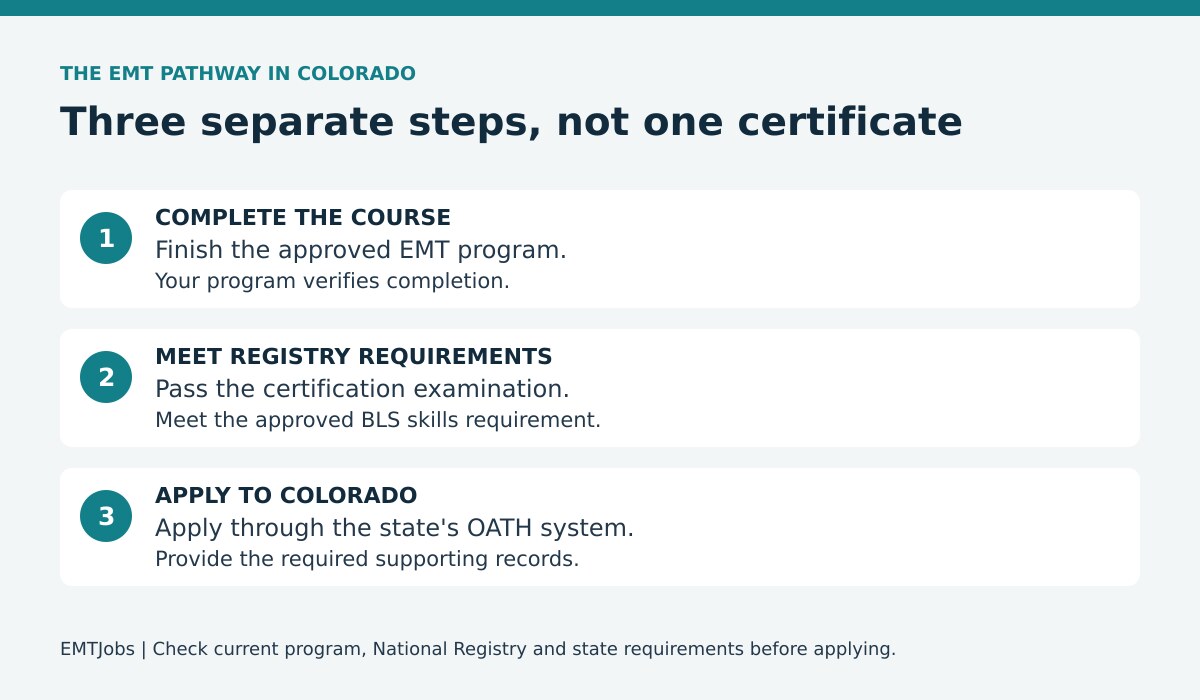
It helps to separate three stages: completing the education program, earning National Registry certification and obtaining Colorado state certification. Passing a class does not automatically complete all three. Denver Health describes its EMT course as preparation for National Registry testing and explains that students can apply for Colorado certification after becoming nationally certified.
For the full education pathway, the National Registry requires successful completion of a state-approved EMT course meeting its education standards. The course must have been completed within the previous two years, and the program director must verify completion. Candidates must also satisfy the Registry’s EMT certification examination requirement and a State EMS Office-approved basic life support skills competency requirement. Some states integrate the skills assessment into the course.
Colorado’s initial EMS provider process requires a current National Registry registration and a separate application through the state’s Online Application Tracking Hub, usually called OATH. Its published requirements also include a valid CPR card and a fingerprint-based background check. Fingerprinting has timing rules, so check the current state instructions before arranging it. Do not assume that a background check obtained for another purpose will be accepted.
Questions to settle before submitting an application
The public course listing is a starting point, not a substitute for the current admissions instructions. Confirm the age and education requirements for your section, any CPR prerequisite, required health documentation, attendance rules and the process for clinical placements. Where a requirement is not clearly stated, ask the school rather than relying on a rule from another EMT program.
- Which campus, building and room will this section use?
- Are clinical or ambulance experiences scheduled outside the advertised class hours?
- Which charges and required purchases are excluded from tuition?
- What happens if you miss a class, need a reassessment or withdraw?
- How does the program verify course completion for the National Registry?
Keep the answers alongside the course description and payment terms. If an employer is helping with tuition, check what it will reimburse and whether it expects you to stay for a particular period afterward. Do not treat a general statement about career opportunities as a job offer or a guarantee of employment with Denver Health.
Deciding whether this is the right starting point
The useful features to investigate are the practicing-paramedic instructors, the published classroom and skills component, and the clinical opportunities described by the school. Balance those against the specific schedule, total cost and travel arrangements. A course that looks attractive on paper still needs to fit your circumstances closely enough for you to attend, study and complete the required assessments.
Related Posts:

If you are still comparing the wider qualification route, the EMT training guide explains the broader starting point. For Denver Health itself, use the school’s current EMT School information and the Colorado EMS provider certification instructions when making an application. Neither this guide nor enrollment alone authorizes you to work as an EMT.